
Need Help?
Office No. 35A, Amanora Chambers, Amanora Town Centre, Hadapsar, Pune, Maharashtra
Open in Maps pgagrisolutions@gmail.com +91 79766 87037Micronutrient Fertilizer Manufacturers in Kolhapur – Pure Grow Agri Solution
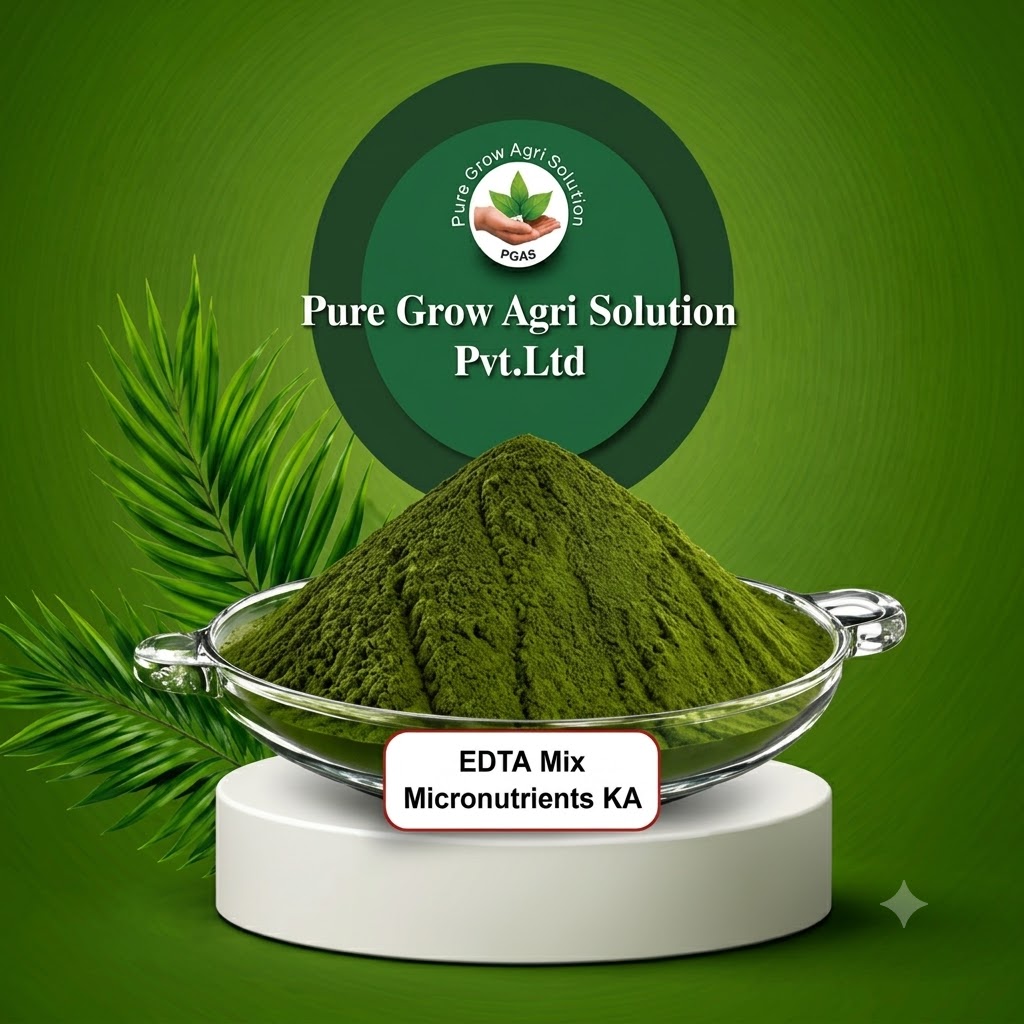


Pure Grow Agri Solutions Pvt. Ltd. is prominent Basic Micronutrient Fertilizer Manufacturers, Suppliers, Dealers, Traders and Exporters in Kolhapur. Our product range includes essential micronutrients, chelated formulations and specialized fertilizer ingredients to address varying plant nutrition requirements.
Our commitment to reliable service and strong business partnerships drives us to support effective nutrient management and healthy crop development.
We serve fertilizer distributors, dealers, agricultural retailers, manufacturers and other buyers looking for dependable nutrient solutions. With an emphasis on product quality and responsive customer support, we help customers explore suitable options for their agricultural needs.
What micronutrients do for a crop?
Micronutrients are needed in small quantities, but no other input can replace them. Zinc runs enzyme systems and growth hormones. Iron and magnesium are part of the chlorophyll that makes a leaf green. Manganese supports photosynthesis, copper strengthens tissue, boron controls flowering and fruit set, and molybdenum helps legumes put nitrogen to use. When one runs short, growth slows, and extra NPK cannot fix it.
The leaves usually give the first warning:
| Nutrient | Main job in the plant | What a shortage looks like |
|---|---|---|
| Zinc | Enzymes, growth hormones, protein | Stunted plants, small leaves, khaira in rice, white bud in maize |
| Iron | Chlorophyll formation | Young leaves turn yellow while veins stay green |
| Manganese | Photosynthesis, enzyme activation | Pale patches between veins, common on light or alkaline soil |
| Copper | Tissue strength, grain set | Wilting tips, dieback, poorly filled grain |
| Magnesium | Centre of the chlorophyll molecule | Yellowing between veins on older leaves |
| Boron | Cell walls, pollen, fruit set | Flower drop, hollow stems, cracked fruit |
| Molybdenum | Nitrogen fixation and use | Pale leaves, weak nodulation in pulses |
| Calcium | Cell walls, root tips | Tip burn, blossom-end rot |
Correcting these shortages brings visible gains: sturdier seedlings, better flowering, even fruit and grain, and plants that cope better with heat and dry spells. How well a plant takes up each nutrient also depends on soil pH, organic matter and the form in which the nutrient is supplied, which is why the types below matter.
Types of micronutrient fertilizers
As Basic Micronutrient Fertilizer Manufacturers, Suppliers, Dealers, Traders and Exporters in Kolhapur, we offer a diverse range of agricultural micronutrient solutions to meet varied crop nutrition requirements.
Micronutrient products fall into four broad types. Each solves a different problem, and most farms end up using more than one.
- 1. Single-element micronutrient fertilizers: These carry one trace nutrient only, such as zinc sulphate, ferrous sulphate or borax. They are the right choice once a soil or leaf test has pointed to one clear shortage, and they are usually the most economical way to correct it. Our single-element range includes Zinc Sulphate 21% and 33%, Ferrous Sulphate 19%, Magnesium Sulphate 9.5%, Manganese Sulphate 30.5%, Copper Sulphate 24%, Borax 15%, Borax 10.5%, Boron 20% (Turkey) and Ammonium Molybdenum.
- 2. Mixed micronutrient fertilizers: A mix puts several trace elements, often zinc, iron, manganese, copper and boron, into one product. It suits routine maintenance, nutrient-poor soils and crops with a wide appetite, and it saves you from buying and applying each element separately. Our mixes include EDTA Mix Micronutrients G-1, G-2, Gujarat Grade, KA Grade, RJ Grade and Drip Grade.
- 3. Chelated micronutrient fertilizers: In a chelate, the metal is held inside an organic molecule such as EDTA or EDDHA. That shield stops the nutrient from reacting with soil minerals and turning insoluble, so more of it reaches the root or leaf. Chelates earn their higher price in alkaline and high-pH soils, where ordinary sulphates get locked up, and wherever fast uptake matters. Our chelated range includes EDTA Zinc 12%, Ferrous 12%, Copper 12%, Manganese 12%, Calcium 9%, Magnesium 6% and EDDHA Ferrous 6%.
- 4. Liquid and foliar micronutrient fertilizers: These are water-soluble products meant to be sprayed on leaves or run through drip lines. Because the nutrient goes straight to where it is needed, they work fast and suit a crop that is already showing a deficiency or entering a demanding stage such as flowering. Our liquid and foliar-ready products include Mix Micronutrient Liquid G-1, 2, 6, Boron Liquid 11% and the EDTA Drip grade.
| Type | Best when | Our products |
|---|---|---|
| Single-element | A test confirms one deficiency | Six sulphates, borax, boron, molybdenum |
| Mixed | You want all-round cover | EDTA mix grades G-1, G-2, state grades, Drip |
| Chelated | The soil is alkaline or you need fast uptake | EDTA and EDDHA grades |
| Liquid and foliar | The crop shows active symptoms | Liquid mix, Boron Liquid, Drip grade |
Single-element range: straight sulphates: Sulphates are the everyday workhorses of micronutrient correction. They dissolve in water, add sulphur along with the metal, and can go onto the soil or onto the leaf.
Zinc Sulphate 21%: This is zinc sulphate heptahydrate (ZnSO4.7H2O), a white crystalline powder that dissolves quickly, so it is a natural pick for foliar sprays. It corrects zinc shortage in rice, wheat, maize, sugarcane, cotton, grapes, pomegranate and vegetables. Use it as a basal dose before sowing, or spray when plants look stunted or leaves come out small and bunched.
Zinc Sulphate 33%: The monohydrate form (ZnSO4.H2O) packs more zinc into every bag, which means fewer kilograms per acre and lower freight. Blenders, dealers and large farms favour it for soil application and for mixing into NPK blends.
Ferrous Sulphate 19%: Green crystals of ferrous sulphate heptahydrate supply iron and sulphur. They are used on groundnut, sugarcane, banana, citrus, vegetables and ornamentals that show yellow young leaves with green veins. A foliar spray gives a quick response on mild cases. On calcareous or high-pH soil, iron is locked up quickly, and EDDHA iron works better there.
Magnesium Sulphate 9.5%: A fast-dissolving crystal that delivers magnesium and sulphur together. It suits banana, grapes, citrus, cotton, pulses and vegetables, especially on sandy or acidic soils where magnesium leaches away. Yellowing between the veins of older leaves is the usual sign. Apply to soil or spray on the leaves.
Manganese Sulphate 30.5%: A high-analysis monohydrate for crops that respond to manganese: sugarcane, wheat, soybean, citrus and potato. Shortage is common on light, alkaline or organic-rich soils. It goes on as a soil dose or a spray, and it is also a standard ingredient in micronutrient blends.
Copper Sulphate 24%: The blue pentahydrate crystal, supplied here as a fertilizer-grade copper source. Plants need very little copper, and too much does harm, so apply strictly as recommended. It is used on citrus, wheat, vegetables and fruit trees, with extra care on sandy and peaty soils.
Borax 15%, Borax 10.5% and Boron 20% (Turkey): Boron decides pollen quality, flowering and fruit set, yet it is the nutrient most often missed. Choose among the three grades by crop, method and budget. Borax is widely used on cotton, groundnut, pomegranate, grapes, cauliflower and tomato, either on the soil or as a spray.
Ammonium Molybdenum (phosphate grade): Supplies molybdenum, which pulses and oilseeds need for nodulation and nitrogen use, and which cauliflower and other brassicas need to avoid whiptail. The dose is tiny, so a small pack goes a long way.
| Product | Active content | Form | Suited for |
|---|---|---|---|
| Zinc Sulphate 21% | Zn 21% | Heptahydrate crystals | Foliar sprays, cereals, vegetables |
| Zinc Sulphate 33% | Zn 33% | Monohydrate powder | Bulk soil use, NPK blending |
| Ferrous Sulphate 19% | Fe 19% | Heptahydrate crystals | Iron chlorosis in neutral to acidic soil |
| Magnesium Sulphate 9.5% | Mg 9.5% | Crystals | Sandy and acidic soils, fruit crops |
| Manganese Sulphate 30.5% | Mn 30.5% | Monohydrate powder | Sugarcane, wheat, soybean, citrus |
| Copper Sulphate 24% | Cu 24% | Pentahydrate crystals | Citrus, wheat, vegetables |
Chelated range: EDTA and EDDHA: EDTA chelates dissolve fully, blend well with most fertilizers and are the usual choice for foliar feeding and drip fertigation. A small dose does a lot of work because the nutrient stays available.
| Product | Content | Common use |
|---|---|---|
| EDTA Zinc 12% | Zn 12% | Cereals, cotton, vegetables, fruit crops |
| EDTA Ferrous 12% | Fe 12% | Chlorosis in fruits, vegetables, flowers |
| EDTA Copper 12% | Cu 12% | Citrus, vegetables, grapes |
| EDTA Manganese 12% | Mn 12% | Sugarcane, wheat, soybean |
| EDTA Calcium 9% | Ca 9% | Fruit firmness, tip burn, blossom-end rot |
| EDTA Magnesium 6% | Mg 6% | Banana, citrus, grapes, vegetables |
EDDHA Ferrous 6% (ortho-ortho): EDTA iron holds up to about pH 6.5. Above that, a stronger chelate is needed. EDDHA iron stays available across a much wider pH range, so it is the dependable option for black, calcareous and alkaline soils where other iron sources fail. It costs more per kilogram, but it works where the soil is the problem.
Mixed micronutrients
When a crop needs several elements at once, a balanced mix saves time and guesswork.
- EDTA Mix Micronutrients G-1 and G-2: general mixes for field crops, vegetables and orchards.
- Gujarat Grade, KA Grade and RJ Grade: formulations matched to the soils and nutrient needs of those regions.
- EDTA Mix Micronutrients Drip: fully soluble, made for fertigation, with no residue to clog emitters.
For specific growth stages we also supply targeted combinations:
- EDTA Calcium + Boron (10% + 2%): supports fruit set and firmness and reduces cracking.
- EDTA Calcium + Magnesium + Boron (6% + 6% + 2%): three nutrients in one for fruit and vegetable crops.
- EDTA Zinc + Boron (13% + 3%): backs flowering and early grain or boll development.
Liquid and foliar products: When symptoms are already showing, speed matters. Mix Micronutrient Liquid G-1, 2, 6 and Boron Liquid 11% are ready to dilute and spray, and the Drip grade goes through irrigation lines to deliver nutrients steadily at the root zone. Spray in the early morning or late afternoon for best results.
From Soil to Plate: The Importance of Micronutrients
Nutritious food begins with healthy soil. Essential minerals such as zinc, iron and manganese contribute to normal crop growth and influence the nutritional quality of agricultural produce. When soil lacks these nutrients, crops may develop deficiencies, highlighting the importance of balanced soil nutrition in producing nutrient-rich foods.
At Puregrow, we focus on agricultural micronutrients rather than human vitamin supplements. We provide essential plant nutrients, including zinc, iron, copper, manganese, boron and molybdenum, to support crop development and effective mineral nutrition. By helping address micronutrient deficiencies in crops, we contribute to balanced plant nutrition and the journey from healthy soil to a better food supply.
Which type should you buy?
| Sulphates | EDTA chelates | EDDHA iron | |
|---|---|---|---|
| Cost per kg of nutrient | Lowest | Moderate | Highest |
| Soil pH it handles | Neutral to acidic | Up to about 6.5 for iron, wider for zinc and copper | Wide, including alkaline soil |
| Best application | Soil, basal, foliar | Foliar, fertigation | Soil, drip |
| Tank-mix behaviour | Can react with some products | Stable with most fertilizers | Stable |
| Choose it when | You want a low-cost correction | You need fast, efficient uptake | Iron shortage persists in alkaline soil |
As a rule of thumb, use sulphates for routine soil correction, chelates and liquids for foliar and drip programs, and EDDHA when iron shortage will not go away in high-pH soil.
Importance of Micronutrients in Crop Production
As Basic Micronutrient Fertilizer Suppliers, Manufacturers, Dealers, Traders and Exporters in Kolhapur, we provide agricultural nutrient solutions that support balanced crop nutrition, healthy plant development and effective nutrient management.
Micronutrients are essential for healthy plant growth, crop productivity and produce quality. Although required in small quantities, their deficiency can limit crop development and reduce the effectiveness of balanced fertilization.
- Supports crop growth: Helps plants achieve their growth and yield potential.
- Prevents nutrient deficiencies: Soil testing and plant analysis help identify nutrient shortages before severe symptoms develop.
- Maintains soil fertility: Replenishing depleted micronutrients supports balanced soil nutrient management.
- Improves nutrient absorption: Suitable soil conditions help plants absorb essential nutrients efficiently.
- Supports produce quality: Adequate micronutrient availability contributes to normal crop development and nutritional quality.
Functions of Micronutrients in Plants
As Basic Micronutrient Fertilizer Dealers, Suppliers, Manufacturers, Traders and Exporters in Kolhapur, we offer agricultural micronutrient solutions that support essential plant functions, balanced crop nutrition and healthy crop development.
Each essential nutrient performs specific functions that support plant growth and development.
- Zinc: Supports enzyme activity, protein synthesis and growth regulation.
- Iron: Contributes to chlorophyll formation and photosynthesis.
- Manganese: Supports photosynthesis and enzyme activation.
- Copper: Contributes to enzyme function and strong plant tissues.
- Boron: Supports cell-wall development, flowering and fruit formation.
- Molybdenum: Plays a role in nitrogen metabolism.
- Magnesium: Supports chlorophyll formation and photosynthesis; it is classified as a secondary macronutrient.
- Calcium: Supports cell-wall structure and root development; it is also a secondary macronutrient.
Benefits of Micronutrients for Farmers
As Basic Micronutrient Fertilizer Traders, Dealers, Suppliers, Manufacturers and Exporters in Kolhapur, we provide agricultural micronutrient solutions that help farmers address nutrient deficiencies, support crop productivity and maintain balanced plant nutrition.
Appropriate micronutrient management helps address crop nutrient deficiencies and supports efficient agricultural production.
- Healthy crop development: Promotes normal plant growth when essential nutrients are adequately supplied.
- Better flowering and fruiting: Supports reproductive development and fruit formation.
- Improved produce quality: Contributes to crop quality and marketability.
- Balanced fertilizer use: Complements nitrogen, phosphorus and potassium in an effective nutrient management programme.
- Nutrient-rich produce: Adequate trace minerals can contribute to the mineral content of harvested crops.
At Puregrow, we offer agricultural micronutrient solutions to support balanced crop nutrition and effective nutrient management. Our focus is to help agricultural businesses identify suitable products for their crop nutrition requirements.
How to apply micronutrients?
Start with a soil or leaf test. The ranges below are commonly used in extension guidance, and your crop, soil and stage may change them, so check with our agronomist first.
| Product | Soil application (per hectare) | Foliar spray (in water) |
|---|---|---|
| Zinc Sulphate | 20 to 25 kg | 0.2% to 0.5% |
| Ferrous Sulphate | 25 to 50 kg | 0.5% |
| Magnesium Sulphate | 20 to 40 kg | 1% to 2% |
| Manganese Sulphate | 10 to 20 kg | 0.2% to 0.5% |
| Copper Sulphate | 5 to 10 kg | 0.1% to 0.2% |
| Borax | 5 to 10 kg | 0.1% to 0.2% |
Spray away from strong midday sun. Do a small jar test before combining products in one tank, avoid mixing sulphates with phosphate-heavy or calcium-heavy products without testing, and never go above the recommended dose, because an excess of a micronutrient can hurt as much as a shortage.
Who we supply, and where?
- Farmers and farmer groups
- Agri-input dealers and retailers
- Traders and wholesalers
- Fertilizer blenders and formulators
- Exporters and importers
Our base is Pune, and we dispatch across Maharashtra, including Pune district, Nashik, Ahmednagar, Solapur, Satara, Sangli and Kolhapur, and onward to Gujarat, Karnataka, Rajasthan and the rest of India. Export enquiries are welcome.
How ordering works?
- Share your need. Tell us the crop, area, soil type and target nutrient, or simply the grade and quantity.
- Receive a quote. We reply with the right grade, pack sizes and price for your quantity.
- Confirm and dispatch. After confirmation we arrange road dispatch within India or documentation for export.
- Get support. Questions on dose, timing or mixing are answered by our team.
Why buyers choose Pure Grow?
As Basic Micronutrient Fertilizer Exporters, Traders, Dealers, Suppliers and Manufacturers in Kolhapur, we combine industry experience, a comprehensive product range and customer-focused service to meet the diverse needs of agricultural businesses seeking reliable micronutrient solutions.
- Over 10 Years of Experience: With more than a decade of experience in crop nutrition, we help customers identify suitable micronutrient grades for their agricultural requirements.
- Complete Product Range: We offer basic sulphates, EDTA chelates, micronutrient mixtures, boron and molybdenum products under one roof.
- Practical Product Guidance: We help customers explore suitable grades and application recommendations based on crop type, soil conditions and growth stage.
- Bulk and Export Supply: We support bulk procurement enquiries from dealers and traders, along with documentation assistance for export orders, subject to applicable requirements.
- Consistent Product Quality: We focus on product specifications and batch consistency to support dependable sourcing and customer confidence.
Choose Pure Grow Agri Solutions Pvt. Ltd. is well-known Basic Micronutrient Fertilizer Manufacturers, Suppliers, Dealers, Traders and Exporters in Kolhapur. We cater to agricultural businesses, fertilizer distributors, dealers and bulk purchasers seeking quality micronutrient fertilizer solutions. Our approach focuses on understanding specific requirements and providing suitable products for balanced crop nutrition and efficient nutrient management. We value long-term partnerships built on responsive communication, dependable support and customer satisfaction. Contact us to explore our basic micronutrient fertilizer range and discuss your business requirements.
Frequently asked questions
There are four: single-element products such as zinc sulphate or borax, mixed micronutrients, chelated grades such as EDTA and EDDHA, and liquid or foliar products. Pure Grow supplies all four.
The 21% grade is the heptahydrate, which dissolves quickly and suits sprays. The 33% grade is the monohydrate, which carries more zinc per kilogram and is preferred for soil use and bulk blending.
Choose EDTA chelates for foliar sprays, drip irrigation and soils where nutrients get locked up. Sulphates are cheaper and work well for routine soil correction.
EDTA iron starts to fail above about pH 6.5, so the plant cannot use it. EDDHA iron remains stable over a far wider range, which makes it effective in black and calcareous soils.
Watch for yellowing patterns, stunting, small leaves, poor flowering or fruit drop, then confirm with a soil or leaf test. Early signs are easy to miss, so testing beats guessing.
Many chelates mix well with common fertilizers. Sulphates can react with some phosphates and calcium products. Always do a jar test, and ask us if you are unsure.
Yes. Send us the grade, quantity and destination, and we will quote with packing and documentation details.
A foliar spray often shows improvement in new growth within one to two weeks. Soil application is slower. Leaves that are already damaged do not recover, but new leaves should come in normal.
Yes. Supplying zinc and other trace elements in the field raises the mineral content of grain and vegetables, which supports better nutritional health for the people who eat them.
Buyers should consider the crop type, soil conditions, identified nutrient deficiency, required nutrient concentration and application method. We recommend reviewing product specifications and soil test results before selecting a suitable micronutrient fertilizer.
Yes, we offer a range of EDTA-chelated micronutrients and mixed micronutrient formulations for agricultural requirements. Buyers can contact us to enquire about available grades, specifications and suitable product options.
Yes, we welcome bulk supply enquiries from fertilizer dealers, distributors, agricultural input retailers and commercial buyers. Please share your required product, quantity and delivery location so we can discuss availability and pricing.
Buyers can enquire about product composition, nutrient content, physical form, packaging options and applicable technical documentation. We encourage customers to confirm the required specifications and product availability before placing an order.
You can contact Puregrow with your required product grade, quantity, packaging preference and delivery destination. Our team can review your enquiry and provide a quotation based on product availability and order requirements.